Online Business
•
How to Improve Your AEO Score (So AI Actually Recommends Your Website)
Your website shows up on Google, but does AI recommend it? Learn how to improve your AEO score in a weekend. Practical steps, no code required.
You spent months getting your website right. Maybe you hired someone. Maybe you did it yourself over too many late nights. Either way, it finally looks professional, it says what you do, and it even ranks on Google.
But here's the thing nobody warned you about: A growing number of your potential customers aren't Googling anymore. They're asking ChatGPT. They're asking Perplexity. They're asking Claude. And when someone types "best personal trainer in Manchester" into an AI tool, it doesn't show a list of ten blue links. It gives one answer, maybe two, and cites its sources.
If your website isn't built in a way that AI can read, understand, and trust, you're not getting mentioned. You're invisible to the fastest-growing search channel on the planet.
The good news? Fixing this isn't complicated. I took my own template store from a 91 to a perfect 100 AEO score in a single afternoon. Here's how to do the same for your business.
Key Takeaways
AEO (Answer Engine Optimisation) is how you get AI tools like ChatGPT, Claude, and Gemini to recommend your website. It's the next layer on top of SEO, not a replacement for it
Most websites fail AEO because of missing structured data, vague copy, and weak page descriptions, not because of bad design
You can diagnose your score for free in 30 seconds using Framer's AEO scanner
The biggest quick win is adding JSON-LD structured data to your site. You don't need to know how to code to do it
A clear, specific website that answers real questions will always outperform a pretty one full of marketing fluff
1. What AEO Actually Is (And Why You Should Care)
AEO stands for Answer Engine Optimisation. It's the practice of making your website visible to AI search tools like ChatGPT, Claude, Gemini, and Perplexity, so they can find you, understand what you do, and cite you when someone asks a relevant question.
Here's the simplest way to think about it:
SEO gets you found. AEO gets you recommended.
When someone searches on Google, they get a list of links. Your job with SEO was to show up near the top. But more and more people aren't searching that way anymore. They're asking AI tools directly, and those tools don't show a list of links. They give one answer and decide which sources to pull from.
Over 60% of searches now end without a click. That number is only going up as AI tools get better. If your website isn't structured so AI can parse it, you're leaving money on the table.
This matters whether you're a personal trainer trying to book clients, a real estate agent wanting premium listings, or a photographer looking for wedding inquiries. If someone asks an AI tool for a recommendation in your industry and your site doesn't come up, your competitor's will.
2. AEO Is Not Replacing SEO. Stop Panicking
Let's get this out of the way because there's a lot of noise about this right now.
AEO is not the new SEO. It's a layer on top of it.
AI search tools pull their information from the same web that Google indexes. If your site isn't properly built for search engines, it's not going to show up in AI search either. Good structure, clear content, and fast loading times all still matter just as much as they always have.
What's changing is that there's now an additional audience for your website: machines that read and interpret your content to generate answers for real people.
Think of it this way: SEO is the foundation of your house. AEO is the fresh coat of paint and the "welcome" sign that makes people (and AI) want to come inside. You can't skip the foundation, but you also can't ignore the fact that the neighbourhood has changed.
If you're already doing SEO well (clear page titles, proper headings, fast-loading pages), you're probably further along with AEO than you think.
3. Diagnose Your Starting Point (It Takes 30 Seconds)
Before changing anything, you need to know where you stand. There are paid AEO audit tools out there, but honestly, most of them spit out confusing reports that create more questions than answers.
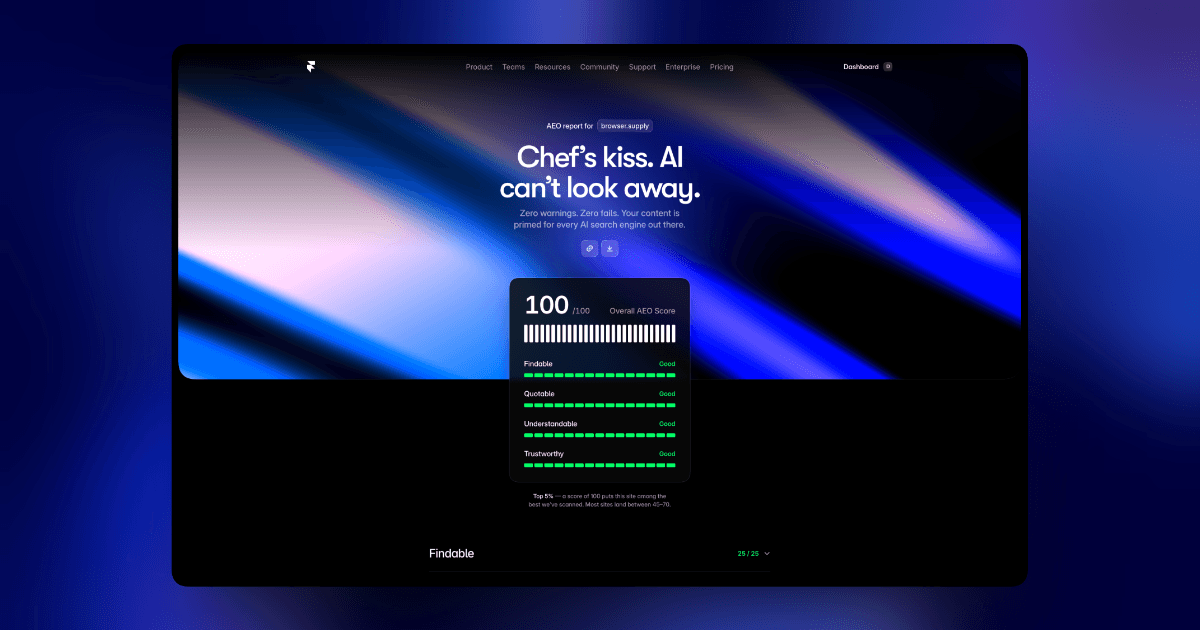
The simplest option: Use Framer's free AEO scanner. Plug in your URL and you'll get a readiness report in about 10 seconds. It scores your site across four categories:
Findable: Can AI crawlers actually discover your pages?
Quotable: Is your content structured in a way AI can extract and cite?
Understandable: Can AI figure out what each page is about?
Trustworthy: Does your site have the signals that make AI confident in referencing you?
When I ran my own template store through it, I scored 91 out of 100. Not bad, but the report told me exactly what was dragging the score down: missing structured data (JSON-LD). One specific, fixable problem.
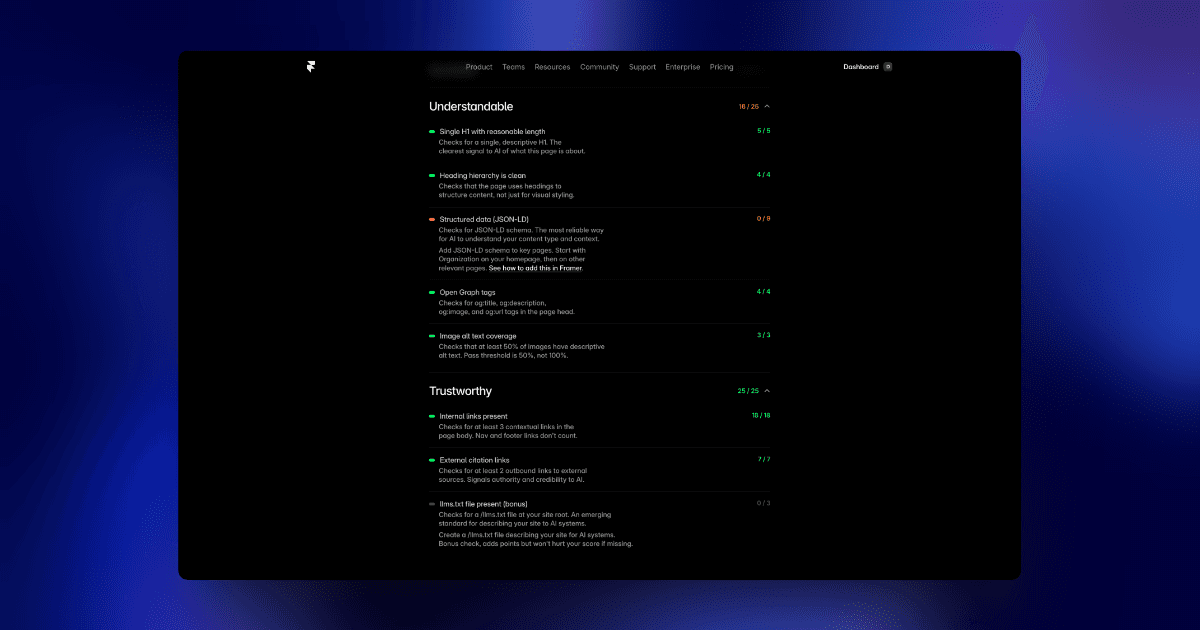
That's the power of scanning first. Instead of guessing what to improve, you get a punch list.
If your business website is built on a template like Meraas or Reformr, you're already starting with a solid structure: Clean headings, fast loading, proper semantic HTML. The scan will tell you what's left.
4. Fix Your Page Titles and Descriptions First
This is the single most overlooked fix, and it's free.
AI tools don't experience your site the way a human does. They're not admiring your hero animation or your color palette. They're reading your page titles, meta descriptions, and headings to decide whether your site is clear enough to reference.
Most small business websites have one of two problems here:
Blank or default titles. The page title is just "Home" or the template default.
Vague marketing speak. The description says "innovative solutions for forward-thinking businesses" which tells nobody (human or AI) what you actually do.
Here's the fix: Write every page title and description like you're explaining to a stranger what that page is about. Be specific.
Bad: "Welcome to our website | Smith & Co"
Good: "Smith & Co | Custom Wedding Cakes in Brighton. Order Online"
Bad: "Our Services"
Good: "Personal Training Packages: 1-to-1 and Group Sessions in Leeds"
Every page on your site is a potential entry point for AI. If someone asks an AI tool "where can I get a wedding cake in Brighton," your page title and description are what the AI reads first. Make them count.
For a site built on a template like EverAfterLens for photographers or Monetize for course creators, this is a 5-minute job that can dramatically change how AI tools interpret your entire site.
5. Cut the Vague Copy. AI Can't Recommend What It Can't Understand
This one hurts because a lot of business owners paid money for their website copy. But if your homepage says "We deliver results-driven solutions for a changing world," AI has no idea what you do. And neither does anyone else.
AI tools favour specificity. They're looking for clear statements they can reference:
What do you sell?
Who is it for?
Where are you based (if local)?
What outcome does the customer get?
If someone asks ChatGPT "best real estate agent website builder," the AI is going to pull from sites that clearly state what they offer. A template like Meraas, built specifically for real estate agents, has copy baked into its structure that speaks directly to that query. Property listings front and centre, agent credibility sections, clear calls to action.
The rule of thumb: if you replaced your business name with a competitor's and the copy still made sense, it's too vague. Your website copy should only work for you.
Go through every page, especially your homepage and services page, and rewrite anything that could describe any business in any industry. Replace it with plain language about what you specifically do and who you do it for.
6. Add Structured Data (JSON-LD). The Biggest Quick Win
This is the one that moved my AEO score from 91 to 100. And despite the technical-sounding name, you don't need to know how to code.
Structured data (specifically JSON-LD format) is essentially a cheat sheet you add to your website's code that tells search engines and AI tools exactly what your page contains. Think of it as labelling everything in your shop so a blind visitor could navigate it perfectly.
For a business website, JSON-LD can specify:
Organization schema: your business name, logo, contact info, social profiles
LocalBusiness schema: your address, opening hours, service area (critical for local businesses)
Product schema: what you sell, pricing, availability
FAQPage schema: questions and answers that AI tools can directly extract
Article schema: for blog posts, with author info and publish dates
Here's the practical approach I used:
Ran the AEO scan to identify which schema was missing
Asked Claude (the AI) to generate the JSON-LD scripts based on my site's content
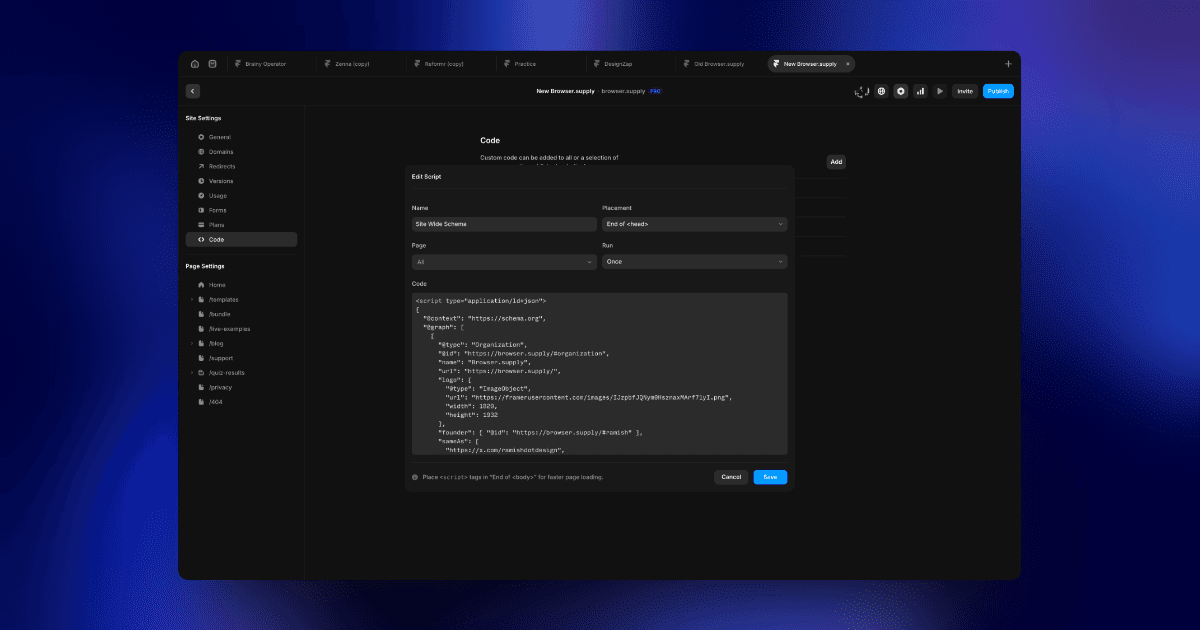
Pasted the scripts into my site's custom code section in project settings
Added page-level scripts for individual pages (like template listings) that needed their own schema
Re-scanned to confirm the score improved
The whole process took 15 to 30 minutes. If your website is built on Framer, there's even a step-by-step guide for adding JSON-LD to your pages.
Not sure where to start? Here's the prompt I used with Claude:
“I need to get structured JSON data for every page on my [URL] site. Here is the official guide from framer: https://www.framer.com/help/articles/structured-data-through-json-ld/”
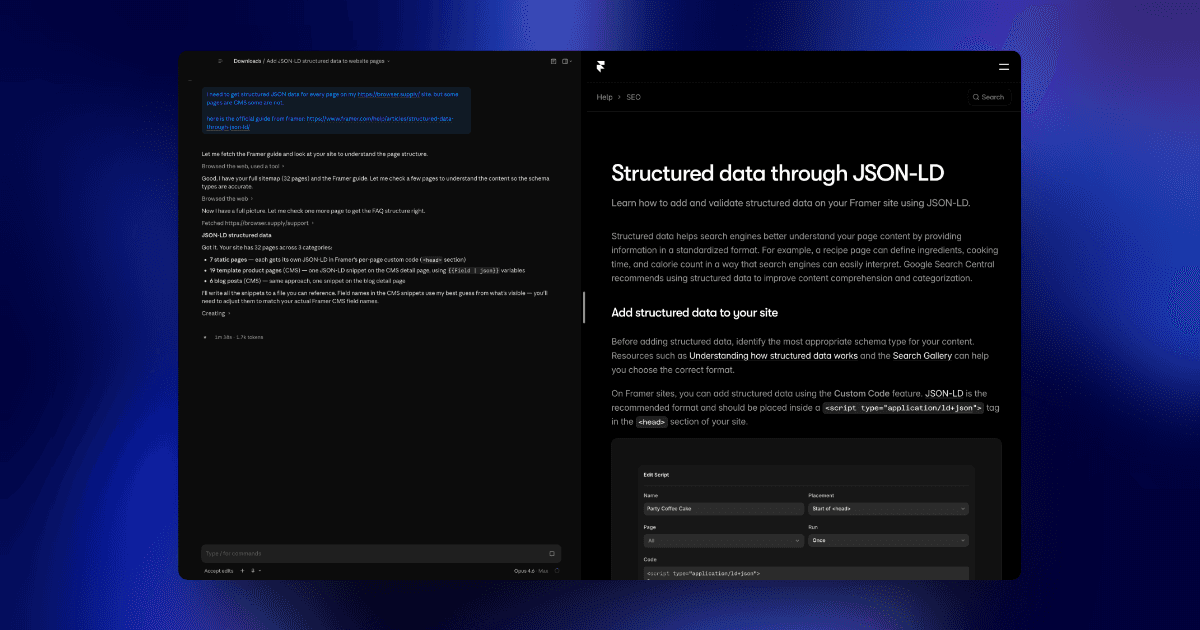
Go back and forth with Claude until you have a refined script. Paste what it gives you into your site's custom code settings. All done without you having to write a single line of code yourself.
For sites built on templates like Cora for SaaS products or Funnelz for service businesses, adding Organization and Product schema alone can bump your score significantly.
7. Structure Your Content So AI Can Skim It
AI tools read your website like a very fast, very literal reader. They don't infer meaning from context or appreciate subtle design choices. They need clear structure.
Here's what that looks like in practice:
One clear H1 per page
Every page should have one main heading that states exactly what the page is about. Not clever. Not creative. Clear. "Personal Training Packages in Leeds" beats "Your Journey Starts Here" every time.
Subheadings that tell a story
If someone read only your H2 and H3 headings, could they understand what the page covers? That's the test. AI tools scan your heading hierarchy to map your content structure. If your headings are vague or decorative, the AI skips ahead to a competitor whose headings actually communicate.
Answer questions directly
Start key sections with a direct answer, then expand. If your heading is "How much does a personal training session cost?" the first sentence should contain the answer, not a three-paragraph lead-up.
This is the same principle behind FAQ sections, and it's why adding an FAQ to your main pages is one of the simplest AEO wins. Each question becomes a potential entry point for AI tools. They treat each Q&A as an individual piece of retrievable content.
Templates like Reformr and Partnr are built with this structure in mind: clear heading hierarchies, dedicated FAQ sections, and content blocks that follow a logical flow. That's not an accident. It's how modern websites need to be built.
8. Keep Your Content Fresh (AI Notices When You Don't)
AI tools favour recent, updated content. A blog post from 2022 that hasn't been touched since is significantly less likely to get cited than something published or updated this year.
This doesn't mean you need to be publishing daily. But it does mean:
Update existing pages when your services, pricing, or offerings change
Publish content regularly that answers questions people in your industry actually ask (even once a month makes a difference)
Remove or refresh stale pages. A dead blog with three posts from two years ago hurts more than no blog at all
Add dates to your blog posts and update them visibly when you make changes
If you're running a coaching business on a template like Partnr, even adding a single FAQ answer each week keeps your site signalling freshness to AI crawlers.
The businesses that win at AEO long-term are the ones that treat their website as a living resource, not a brochure they published once and forgot about.
Not sure which template fits your business? The Browser Supply quiz matches you with the right starting point in under a minute.
9. Add an llms.txt File (Advanced, But Worth It)
This one's for the slightly more ambitious crowd, but it's becoming increasingly important.
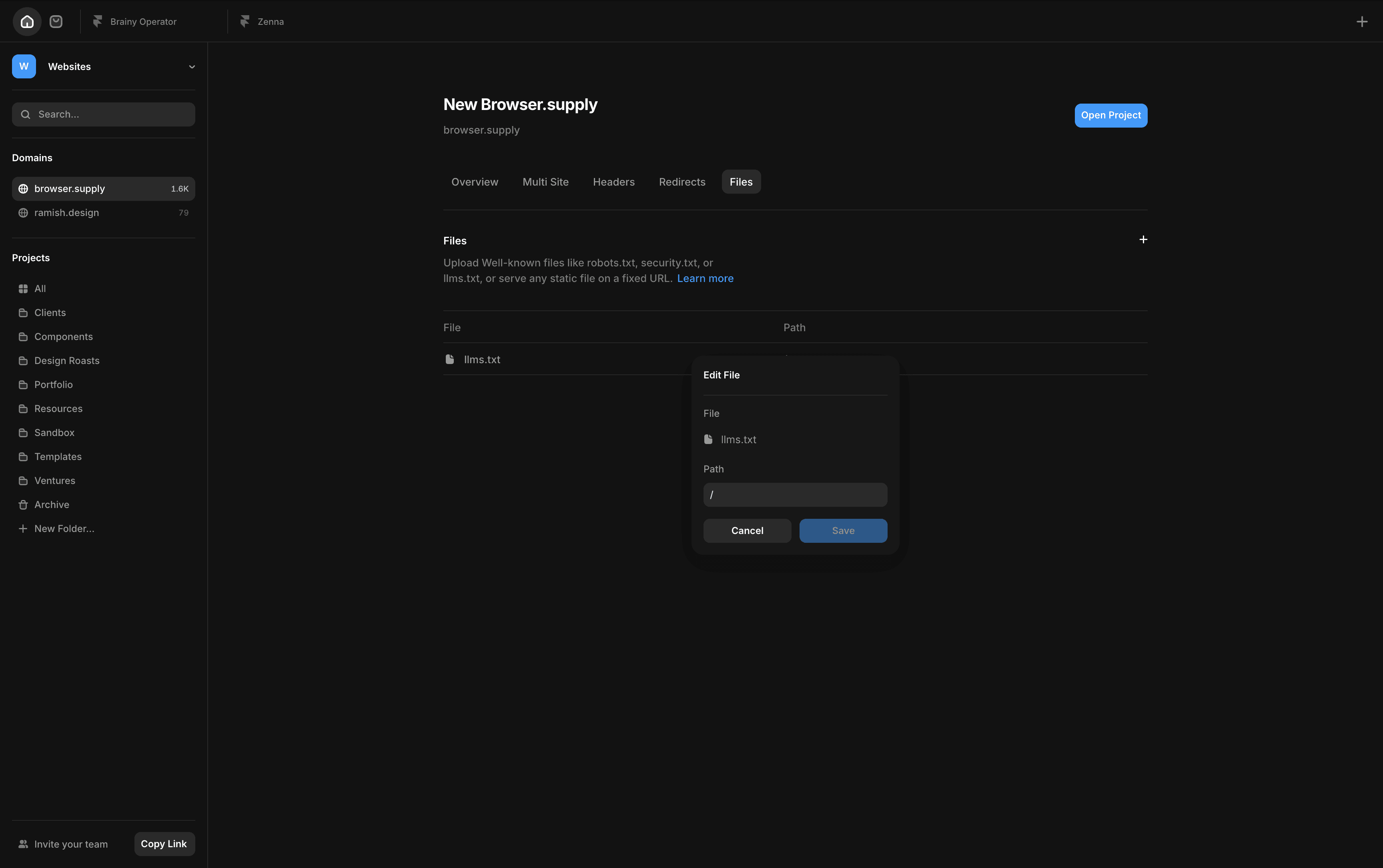
An llms.txt file is like a robots.txt file, but specifically for AI crawlers. You place it at the root of your domain (e.g., yourdomain.com/llms.txt) and it acts as a curated index telling AI tools which pages on your site are most worth reading.
Think of it as a guided tour for AI. Instead of letting an AI crawler wander your entire site and decide what's important, you're pointing it directly at your best content:
Your main services page
Your pricing page
Your top blog posts
Your FAQ pages
Comparison pages ("us vs. competitors")
And you're telling it to skip the pages that don't add value: login pages, account sections, thin landing pages.
This isn't standard practice yet for most small businesses, but the ones doing it now are getting an edge. If you're building on Framer, you can add this through your site's custom code settings, same place you'd add the JSON-LD scripts.
10. Re-scan, Iterate, Repeat
AEO isn't a one-time fix. It's an ongoing practice, the same way SEO has been for the last decade.
After making changes, re-scan your site. Compare your new score against your starting point. Framer's scanner will show you exactly which checks you've passed and which still need work.
Here's a realistic monthly rhythm:
Week 1: Run AEO scan, note any new issues
Week 2: Fix the issues (usually page titles, fresh content, or schema updates)
Week 3: Publish or update one piece of content that answers a real question in your industry
Week 4: Re-scan, check Search Console for any changes in how your pages appear
The businesses that treat AEO as part of their routine, not a one-off project, are the ones that stay visible as AI search tools evolve.
I've seen first-hand what happens when you take it seriously. My template store went from 91 to a perfect 100, and the process was simpler than I expected. The same approach works whether you're running a fitness business like Reformr, a recruitment agency like Talentify, or a branding studio like Logofolio.
Want every template in one go? The Browser Supply bundle gives you all 18 industry-specific templates, each one built with clean structure, proper headings, and AEO-ready foundations.
Your Website Doesn't Just Need to Rank. It Needs to Be the Answer
The way people find businesses is changing. Not slowly. Rapidly. AI tools are already shaping buying decisions, and the websites that show up in those conversations are the ones built with clarity, structure, and specificity.
You don't need to become an SEO expert or hire a technical consultant. You need to:
Scan your site and know your starting point
Write page titles and descriptions that actually say what you do
Replace vague copy with specific, honest language
Add structured data so AI tools can read your site properly
Keep your content fresh and useful
If you do those five things, you're ahead of 90% of small business websites right now. That's not hyperbole. Most sites still don't have basic structured data, let alone an AEO strategy.
The sooner you start, the further ahead you'll be when your competitors finally catch on.
Start with the right foundation. Browse the full Browser Supply template collection. Every template is built with clean semantic structure, proper heading hierarchies, and fast loading times. Pick your industry, add your content, optimise your AEO, and launch a site that AI actually wants to recommend.